
A Case of Mistaken Identity
January 29, 2026
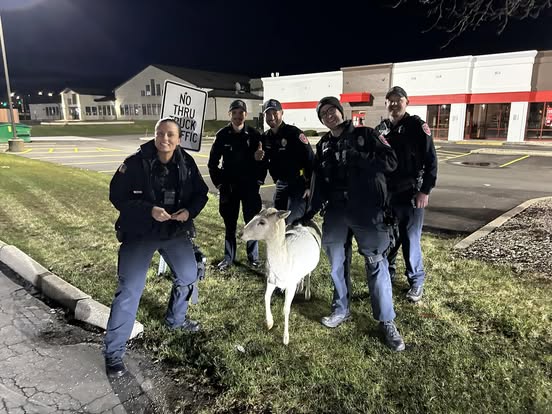
Oak Creek officers stopped this suspicious character for questioning.
(Photo courtesy of Oak Creek Police Department)
On March 31, 2024 (Easter Day) the Police Department in Oak Creek, a south Milwaukee suburb, posted a photo of several officers standing around a white-colored deer. The caption read:
Third shift officers contacted a nocturnal prowler tonight. The subject claimed to be out assisting a cousin, who was filling baskets for a holiday of some sort. The subject was identified and released.
The photo soon went viral and several newspapers did articles on the special deer. It turns out Penelope, as the deer was called, had been hanging out with more than just Easter bunnies and police officers. Penelope was already a neighborhood fixture.
On November 28, later that year (Thanksgiving Day this time), police in the nearby city of Greendale received reports of a “white alpaca or goat” wandering through the neighborhood. Police assured the public it was just a deer “doing what deer do.” It was Penelope. There was no mention of her hanging out with turkeys.
A Neighborhood Icon
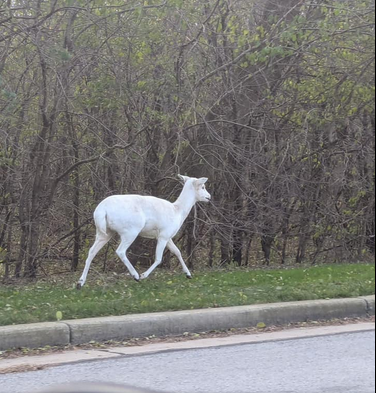
Photo credit: Heather Bohl
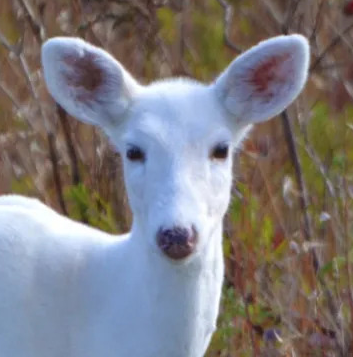
Deer are not uncommon in urban landscapes, but Penelope is unique: she has a white coat and she is abnormally friendly, often eating out of people’s hands.
Penelope is also quite the traveler—frequenting not only Oak Creek and Greendale, but also the communities of Franklin, Caledonia, Raymond, and even Franksville.
Penelope can usually be found along creeks, in parks, or snacking at backyard bird feeders. Residents often post updates about her on social media and include photos of people petting Penelope or taking selfies with her.
According to “Greendale Under the Bubble,” a community Facebook page, Penelope is a Greendale icon. One post on the site calls Penelope a “Milwaukee County angel.” Another post (on a little more humorous note) predicts an “albino deer tax coming to village residents.”
The Facebook page “Penelope in Greendale“ says Penelope has been around since before 2017, making her at least 9 or 10 years old. The page also says Penelope escaped from a deer farm, which would explain why she is so tame. Some posters say she escaped from a petting zoo.
Despite the hazard of living close to speeding cars, Penelope is still alive and well (her most recent sighting was on January 25). Maybe she’s got that car thing figured out—one person described seeing Penelope wait to cross a street until the light changed. The viewer was impressed.
The White Deer Look-Alikes
Now, here is a bit of information the police officers in Oak Creek and Greendale may have missed. Penelope is neither a whitetail nor a “white deer” (a mutation that is genetically unable to produce color).
Her crime? Impersonating a deer of another species. She may also be guilty of identity theft (stay tuned).
Penelope’s Greendale Facebook page sets the record straight: Penelope is actually a European fallow deer. This mix-up has happened with a number of fallow deer across the country, but even though the two kinds of deer are similar, they are different in several ways.

L: Fallow deer are shorter and stouter than whitetails (Karl Mondon/Bay Area News Group) R: Whitetails have longer legs and a longer nose and ears (Mike Crowley video screenshot)
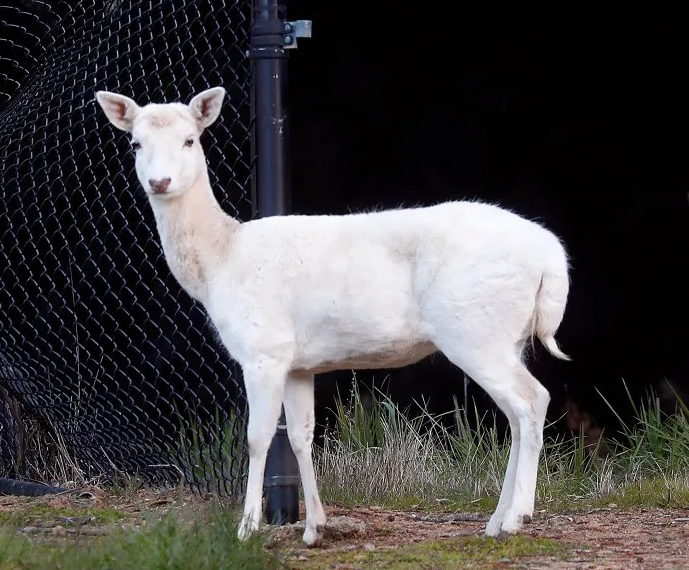
Fallow deer are smaller, have stouter bodies, and are more easy-going. They come in several color variations: reddish or tan with white spots (even as adults), dark brown to black, and cream to white. Males also have palmate or flattened antlers, which make them much easier to identify.
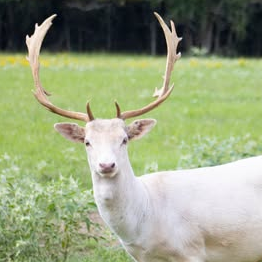
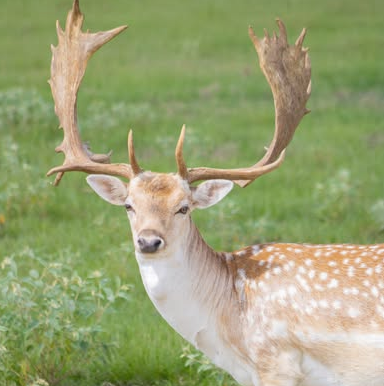
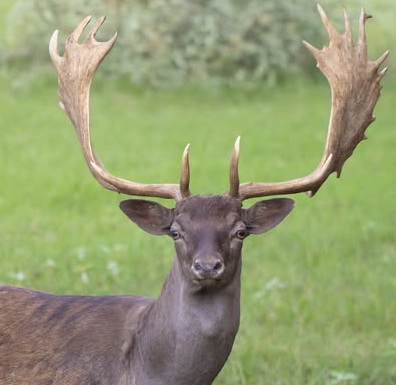
Color variations in fallow deer. L-R: cream or white, reddish or tan with white spots, and dark brown or black. (Photos from Zoofari)
White fallow deer have a color more like domestic animals—they are not the “detergent white” or “glow-in-the-dark” white like true albinos or white-coated (leucistic) whitetails. It’s a matter of different genetics and hair structure, which affect how light is reflected.
Another give-away: fallow deer have broad foreheads and wide-set eyes that are more reminiscent of sheep.

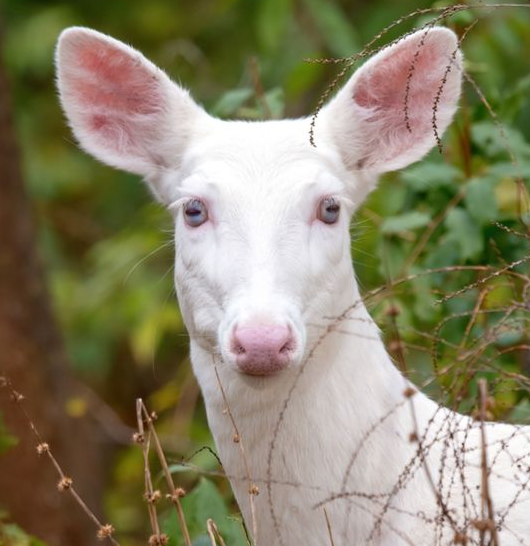
L-R: A sheep, a white fallow deer, an albino whitetail (with light-colored eyes), and a leucistic whitetail (with brown eyes).
But the biggest difference between fallow deer and whitetails isn’t even something you can see. One Facebook poster referred to a picture of a handsome white whitetail buck in a Waukesha news story and wrote, “Imagine if him and Penelope would end up, er, um.. you know.”
Nope…not going to happen. Even if they lived closer together, fallow deer and whitetails have different numbers of chromosomes and do not interbreed.
A Little History
Fallow deer originally came from Southern Europe, the Mediterranean, and Asia Minor. Their more worldwide distribution started a couple thousand years ago when Roman armies took herds of fallow deer with them as a food supply (which gives new meaning to “fast” food and “food to go”).
Range Map for Fallow Deer (from Wikipedia):
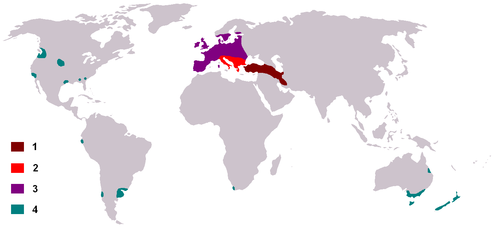
1) Brown – original/native range 2) Red – possible native range 3) Purple – Early human introductions 4) Green – modern human introductions
For many years fallow deer were commonly kept on estates for hunting–Robin Hood may very well have been poaching fallow deer from the King’s forest. Fallow deer today are still prized as an ornamental species and for hunting.
Fallow Deer in the United States
Three herds of fallow deer were particularly famous in the U.S. All three began as introduced herds on wealthy estates that later became public land (the deer apparently came with the land).
One of these famous herds was located at Point Reyes National Seashore (pronounced Rays), a coastal park in northern California about 30 miles north of San Francisco. The herd had mixed color types, but the white ones were the most popular.
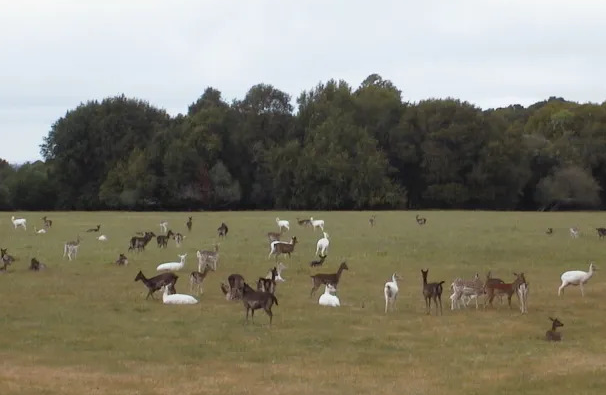

L: Some of the free-range fallow deer at Point Reyes (National Park Service)
R: A Rocky Cliff area known as Chimney Rock at Point Reyes (Wikimedia)
Another famous herd (all white) was located at Mt. Madonna County Park about 80 miles south of San Francisco.
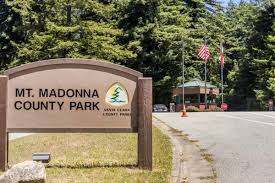
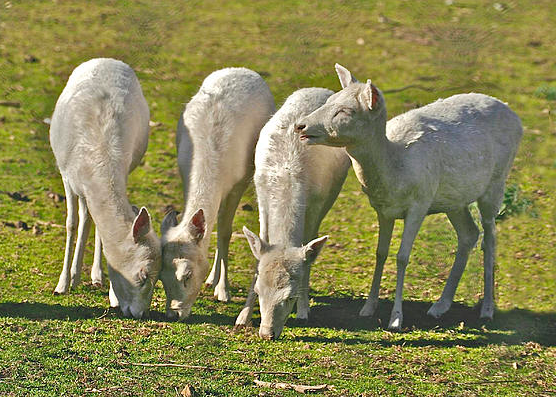
L: The entrance to Mt. Madonna County Park, CA. R: Several white fallow deer–part of a herd that was kept in large pens at the park. (Mt. Madonna County Park)
A third herd (also all white) lived at the Argonne National Laboratory, a nuclear research facility located 25 miles southwest of Chicago. Although people joked (kind of) about the deer’s white color being caused by leaked radiation, the white deer were there long before the lab was (early 1900s for the deer; 1946 for the lab).
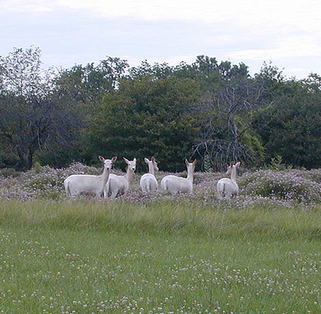

L: Part of the herd of white fallow deer that used to live on the Argonne grounds.
R: The particle accelerator at the Argonne Lab (photos from Argonne National Lab)
The deer at Point Reyes, Mt. Madonna, and Argonne were major tourist attractions for many years–Facebook pages are filled with people recounting fond memories of visiting them as children. But despite the deer’s popularity, none of the herds were destined to last. The era of exotic species was just about over.
The End of an Era
Wanting to limit the growing numbers of “alien” deer and the environmental damage they were causing, administrators proposed large shooting culls at both Point Reyes and Argonne. Despite massive public opposition, the culls went ahead. Most of the Point Reyes deer were killed and the remaining small Argonne herd–intended to be “sustainable”–collapsed instead. The last recorded sighting of a “white deer” at Argonne was in 2016.
Population control of the fallow deer at Mt. Madonna Park took a different tack. The park put males and females in separate pens (death by attrition rather than guns). Despite the herd surviving an earlier poaching incident and a cougar that killed over two dozen deer, the herd could not survive the growing movement against introduced species. Only one white fallow deer remains alive today.
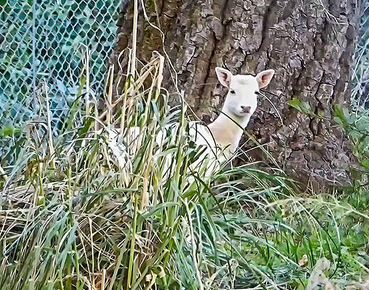
The last white deer at Mt. Madonna. She’s very shy–perhaps wary of the “predators” that must have taken the rest of her herd. (CBS News Bay Area video screenshot)
Mt. Madonna’s last deer remains a celebrity, though perhaps a lonely one. Her name is…Penelope. And now you know where the Wisconsin Penelope got her name.
By the way, the picture further up the page–of the fallow deer next to the whitetail–that’s Penelope (the California Penelope).
Where Things Are at Today
Nowadays the most common place to find fallow deer is on hunting preserves (particularly in Texas), where large-antlered fallow bucks can be hunted for a fee. The deer still retain the novelty they had hundreds of years ago and are occasionally kept on private farms where, yes, they sometimes escape.
And then they get their picture taken and become the next “white deer” sighting on the local news or on someone’s Facebook page. Or they get “stopped” by law enforcement for suspicious behavior after dark in a populated neighborhood.
South Milwaukee’s Penelope has actually racked up a long list of offenses: stopping traffic, loitering, suspicious behavior, trespassing on private property, pilfering bird food, impersonating another deer species, identity theft, and being an animal of interest.
Whether it’s imitating a whitetail deer, stealing attention, or just endearing herself to a neighborhood, Penelope is definitely a repeat offender.

