The Poaching of A White Deer-The Biggest Story That Never Was
February 24, 2026
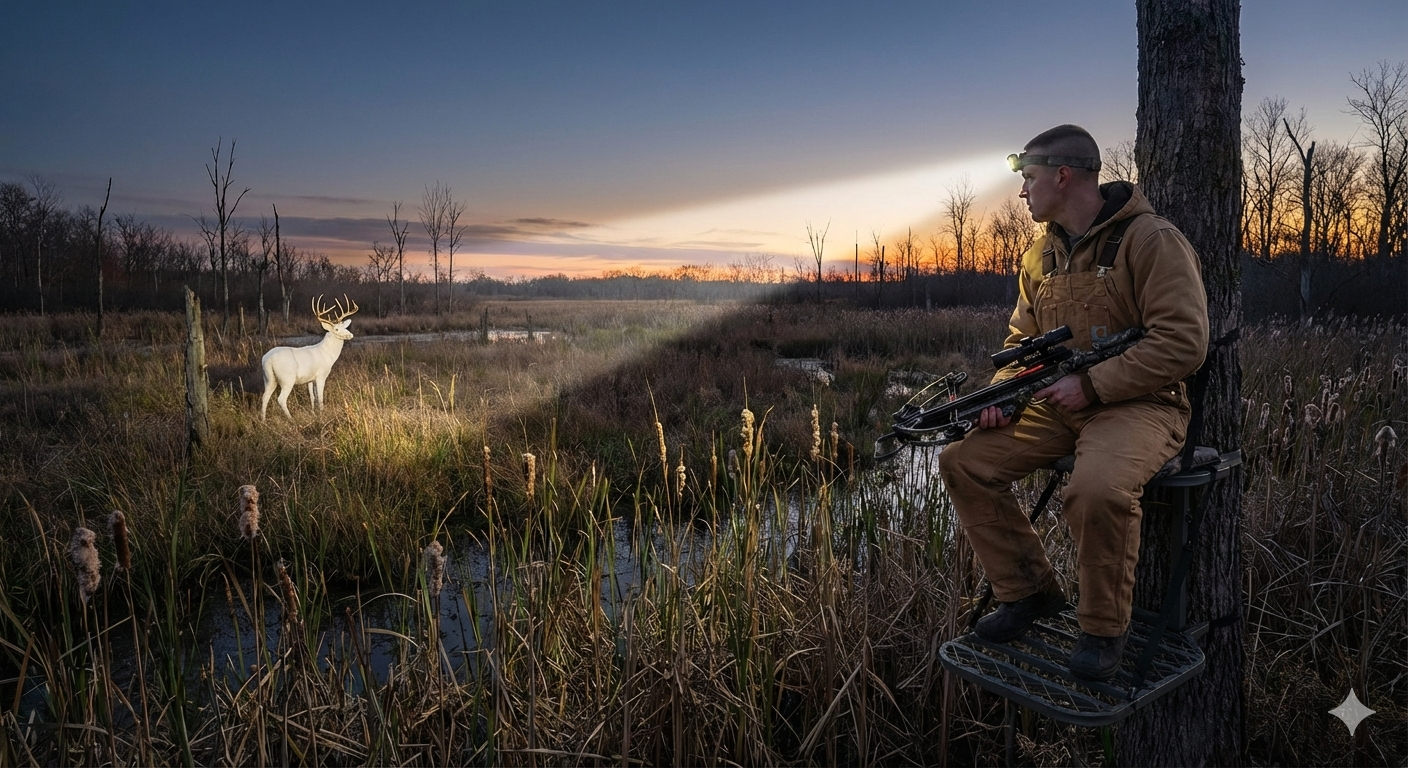
2024: A white buck in a Wisconsin marsh passes by a hunter’s tree stand. It is illegal to shoot white deer in Wisconsin and it is illegal to hunt after dark. The story that follows should have been major news, but it wasn’t. What happened? AI image by Protect the White Deer.
A little background
The killing of a popular white buck near Leland, Wisconsin in 2012 created a few seismic tremors in an otherwise quiet community. People were outraged. White deer had been illegal to hunt in Wisconsin for many years, but protection had recently been removed in a CWD (chronic wasting disease) zone, which happened to include Leland.
A Madison TV station did a story on the killing, the wire service picked up on it, and the story went viral across the country—even making the Daily Mail in Great Britain. Locals organized the Protect the White Deer group to fight for legislation to protect the remaining white deer in the area.
Two similar “outrage” stories happened in 2014 outside Wisconsin: a popular white buck was shot in Missouri and another one in Michigan. They were both legal kills (neither state had white deer protection), but the deer had been longtime community favorites. The outcry was even worse (it got nasty).
Fast forward to 2024
A well-known white buck was again killed in Wisconsin, this time in 2024 during the state’s archery and crossbow season. The story was a little different this time though–the deer was not legal to hunt and it died a particularly gruesome death. The kill crossed the unethical line and went full illegal.
So, how is it that the most outrageous of “outrage” stories happened, and nobody even heard about it?
The story finally comes out
On September 16, 2025, almost a year after the shooting, some of the white buck’s story finally came out. Deer hunter Jacob Sklenar described on a YouTube channel called The Hunting Beast what happened close to his tree stand on November 7, 2024.
Jacob was hunting that day on public land in Southeast Wisconsin (Jacob is very general about the location). The area was vast and marshy with no developed trails. During the day Jacob saw two of the main characters in this story: a large white buck, plus a crossbow hunter with a quiver on his back containing two green-feathered bolts (short crossbow arrows).
The white buck often hung out in the marsh (Jacob called him his “old friend’) and was probably 9-10 years old. Just about everyone who hunted on that land had “crossed paths with him.” It was now illegal to shoot white deer anywhere in Wisconsin (statewide protection had been reinstated in 2014), so the buck wasn’t particularly wary around people.
The trail camera evidence
Another thing to know before the story continues: the area was full of trail cameras. The DNR allows them on public land as long as they are in legal hunting areas and are identified. Jacob had two trail cams, but one was crucial–it was a cell cam, a special kind that sends alerts and photos directly to a person’s cell phone.
Just three minutes before closing light, which is 20 min. after sunset and the end of legal shooting hours, Jacob received a photo: the white buck was passing by his cell cam. Twelve minutes after closing light, just a short while later, the buck again passed in front of the camera going the opposite direction. But something was terribly wrong.
The buck was hunched over with its mouth open, panting, and in extreme “stress” (as Jacob described it), but “agony” might be a better word. Sensitivity warning: the deer “was bleeding out” and its guts were exposed below its body.
The sharp blades of an arrow appeared to have entered the buck’s side and sliced through its underbelly. The arrow could have also punctured the deer’s lungs or diaphragm, which would have made it difficult for the animal to breath. He wasn’t going much further.
About 20 minutes after this disturbing scene, while Jacob was taking his stand down, he received a third cell cam photo. This one showed the hunter Jacob had seen earlier in the day walking past the camera—likely looking for the deer.
Although Jacob shows several photos of the hunter during his story, he always has the hunter’s face blurred out or covered with an emoji (more on this later).
The hunter is caught
Jacob immediately messaged all his hunting friends on the property, explained what had happened, and told them to get back to the parking lot to see if any unfamiliar cars were parked there. There was only one, and it was the poacher’s.
Jacob called the local wardens next, but they weren’t able to come out right away. Two police officers were dispatched instead, drove to the parking lot, and met the poacher as he came back to his car. Two wardens from an adjacent county also arrived in time to question the hunter.
The hunter denied shooting any deer and was allowed to leave, but the trail cam images of the hunter pretty well proved he had made the shot. He was also missing one of the two bolts in his quiver. The wardens then did a search and found the dead deer only a few yards past the trail cam. A search the next day also found the green-feathered bolt.
In the following days, Jacob asked all his friends to check their trail cams for photos of either the white buck or the hunter. The results enabled him to pretty well map where the two had been and create a timeline. The crossbow hunter was definitely guilty. “Everyone wanted to see justice prevail on this poacher.”
Jacob figured the whole case was open and shut, but the official investigation would take much longer. Jacob was told not to talk about the case, since releasing information could compromise both the investigation and the prosecution. Another hunting season would roll around before Jacob could tell his story.
Examining motives
When Jacob finally told his story on the “Beast Report,” the poacher had no name and no face. Jacob and the show’s hosts, however, did ponder why the hunter would make such an illegal and ill-considered shot–how could he even move the deer without being seen? They finally concluded the hunter was somewhere between a flawed human being…and a serial killer.
On Dec. 6, 2025, Jacob put his story up on his own YouTube channel called The Wild Calling. “Watch this dramatic story unfold in a wild case of true crime in the outdoors!” the intro teases.
Jacob also posted his story on several Facebook pages, but was unprepared for the “raking” he was about to get. Most people praised his actions, but a few accused Jacob of using AI photos or making up a story to get publicity for his own channel. A few even sided with the poacher.
What shines in all Jacob’s interviews, though, is that he is very law-abiding and careful. An engineer by training, he shows all the characteristic traits of an engineer: logical, analytical, persistent, focused, and good at problem solving. Engineers also (according to Google) “understand the necessity of teamwork for large-scale, complex projects.”
In addition, Jacob is very caring–not from any advanced math or physics courses–but, as he tells the Beast Report hosts, from having decent role models in his life. He even gives the poacher the benefit of the doubt—expressing hope that the event will be a lesson for him rather than a life-time indictment (and, it could be added, to save him from a lot of angry Facebook posts).
The poacher is charged
On January 15, 2026, Jacob appeared in a new video on Facebook with an update on the case. The poacher had finally had his day in court.
The hunter had four charges against him: shooting an illegal animal, shooting a deer after dark, leaving a kill, and lying to police. His lawyer, however, was able to plea bargain the list down to just one charge: illegally shooting a protected animal.
The poacher received a fine of just $350 (equivalent to about two speeding tickets) and had his hunting license revoked for one year. He didn’t even have his crossbow confiscated, which is usually done in a case like this. Even hunters were stunned by the leniency.
One person commented: “(This) slap on the wrist sentence is totally insulting to those of us that do everything we can to follow the letter of the law. People make mistakes, but this was no mistake. Should have been AT LEAST a 5 year ban AND $20k fine.”
The poacher, however, probably felt it in the wallet a little more than the fine suggests. Legal costs for a misdemeanor game violation are typically between $1500 and $5,000. And, like they say, going through the whole legal process is a punishment itself.
The big silence
How do nonhunters feel about all this? They mostly aren’t in the picture right now because the discussion about the white buck’s death hasn’t gotten beyond a few hunting platforms. No news stories, no wire service, no national headlines, no Daily Mail.
Missing are the usual accounts of seeing the deer alive, sharing photos, and being in awe of the deer’s unique beauty. Also missing is the outrage over the deer’s death. For every person that kills a white deer–legal or illegal—there are a hundred more that would love to give the shooter a one-way ticket out of town.
Jacob is right about one thing: the news would have been huge and the poacher would have been condemned on a massive scale. But is keeping this story silent going to stop future poachers–the ones with an itchy trigger finger, low impulse control, and little regard for the law? And doesn’t the community have a right to know?
The DNR does not typically release information during an investigation, but once citations are issued, the records are public. News sources can and do routinely reveal names and charges before there is even a court date or trial. So, why didn’t this story get out?
A similar poaching case
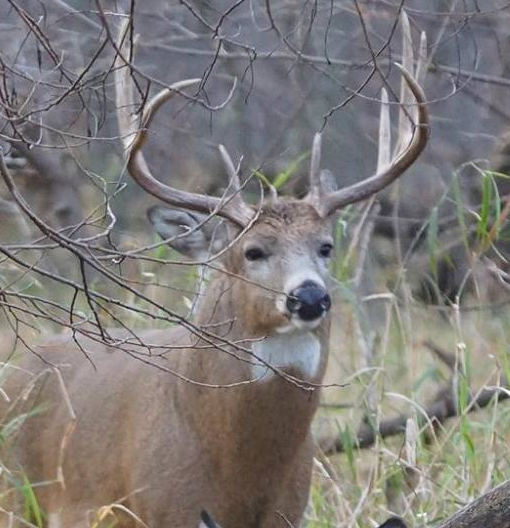 A similar poaching case, but one that quickly made the news, occurred in Wauwatosa, a suburb of Milwaukee, on December 13, 2015. The buck that was killed wasn’t white, but it had a unique white throat patch that looked like the deer was wearing a bow tie (all dressed for the annual whitetail ball, no doubt). He was an extremely popular animal and should have been safe–Milwaukee County doesn’t allow hunting in any of its parks.
However, Bow Tie was shot–by a hunter with a crossbow (crossbows, for some reason, seem to come up in a lot of these stories). A quick-thinking park-goer who encountered the poacher was able to alert police.
Contrary to the quiet after the white buck’s killing, this shooting was big news just two days after the incident occurred. Milwaukee Journal Sentinel outdoor columnist Paul Smith even did an article about the buck. Protect the White Deer also did an article.
The fine in this case? Jason Elliott, the hunter, pleaded no contest in January (only one month after the shooting). He was ordered to pay $1,540, had his hunting and fishing privileges revoked for one year, and had his equipment (including crossbow) confiscated. The penalty was steeper than what the white deer poacher received, but was still relatively mild.
People were again upset: Randy Crawford, the hunter and wildlife photographer from Wauwatosa who nicknamed Bow Tie, told the press that fines never seem adequate for the illegal killing of wildlife. “I think poaching would decrease if fines were stiffer…It’s hard to catch them, but something should be done to send a message.”
Where is the white buck now?
The remains of the white buck are now in Jacob Sklenar’s possession. The carcass was frozen during the investigation to preserve evidence. Once the case was done, the DNR debated what to do with it.
It wasn’t worth the cost of an auction (which the DNR sometimes does). They couldn’t sell or give away the meat after this length of time. The next possibility: just give it to someone, and Jacob was their first thought, since he had put so much effort into catching the poacher. (He did have to pay $10.)
Jacob says he will probably do a shoulder mount because of the cost, but several people have offered to chip in for a full mount or suggested using GoFundMe. If Jacob hadn’t taken the carcass, it could have ended up in the dumpster—an even sadder ending for such a magnificent deer.
Jacob hopes the deer will be a “symbol” of how hunters can work together to protect not only game laws, but the reputation of hunters in general—something that really takes a beating in a case like this.
Final thoughts and Issues
Not getting the white buck’s story out deprived the public of both a major story and a teaching moment. At this point, though, it is no longer a “hot” story for the evening news. The irony is that if this had been a legal kill (no investigation required) the story might have gotten out much sooner.
Poaching fines do need to be bigger, and there needs to be added fines for special deer like white deer, which are extremely rare and very popular. That value should be reflected in larger fines. Many states have higher penalties for poaching trophy bucks, so it can be done.
This case also brings up the difficulty wardens have nowadays of identifying violators. With a combo of backtags and trail cams, this case could have been an instant slam dunk. No longer requiring backtags (2016) or in-person registration (2015) removed virtually all accountability for hunters.
The other issue this story brings up is the enormous prevalence of trail cams almost everywhere (potential poachers, take note). This can be very useful, but, as one reader commented: “Don’t get me wrong (I’m) glad they got the guy but talk about a surveillance state, this is probably what its like living in china but its here and (on) just some random public hunting property.”
The wardens in this case need to be commended. They worked through the night to find the deer, get it out, and gather evidence–not finishing up until the deer was delivered to a DNR facility in Madison at 3:00 in the morning. They also did more work in the following days searching the property, checking all the trail cams in the area, and questioning the poacher at his home. A $350 poaching fine was an insanely small amount of money for so much time and work.
The anonymous victim
A large white buck anywhere is a known member of the local community. What was his name (well-known animals always have names)? Where did he travel and where was he seen in his 9-10 years?
The poacher’s face in several of Jacob’s photos is blurred out or covered with an emoji, but in a sense, the white buck has a proverbial emoji over his face, too.
The poaching of the white buck was only the ending chapter in this deer’s life. What was the rest of the buck’s story? Jacob might not know, but lots of other people could provide pieces to put this picture together.
Jacob wants to use his story to advocate for ethical hunting and to show how hunters can cooperate with each other and law enforcement to catch poachers. That’s all good. But any mount of the white buck should also be a memorial to a beautiful deer that was enjoyed, photographed, and then almost forgotten. This was a story that needed to be told–not just to a few, but to everyone.
Final note
Protect the White Deer did request and receive WI DNR records for this particular case, so yes, the poacher’s name and the location of the crime are known. Out of respect for Jacob, who essentially captured the poacher and brought the story at least to the hunting public, we are not going to give out that information. Hopefully, Jacob will provide more details in the future so everyone can benefit from what was a really horrific crime. There is so much more to this story (like wardens using a kayak to get the deer back to the parking lot, and the poacher switching bolt types in his garage to throw off investigators). It really was a “true crimes” story.

